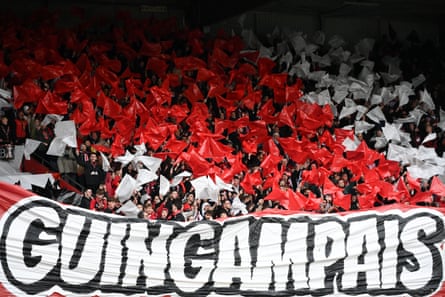

Facing financial headwinds, French football clubs are increasingly turning to their fans for support through the ‘socios’ model. Inspired by successes in Spain and Germany, clubs like Guingamp, Sochaux, and Bastia are offering supporters a chance to own shares, fostering community engagement and financial stability. This trend marks a shift in French football, emphasizing collective action and offering hope for a more sustainable future.
In a landscape where French football clubs are increasingly grappling with financial instability, a glimmer of hope has emerged from an unexpected quarter: the fans themselves. Inspired by successful models in Spain, Sweden, and Germany, a growing number of French clubs are opening their doors to supporter ownership, adopting the 'socios' model to navigate challenging times.
France boasts a rich tradition of not-for-profit associations, with a staggering 1.5 million organizations dedicated to various causes, from amateur mycology to international disaster relief. However, until recently, this spirit of collective action has been conspicuously absent from the realm of organized football. Club ownership in France has historically been the domain of private individuals, local authorities, and businesses establishing teams for their employees.
This paradigm is now shifting, with fan groups organizing themselves into 'socios' associations to acquire shares in their beloved clubs. While the phenomenon is still in its nascent stages, with only a handful of clubs affiliated with the Fédération des Socios de France (established in October 2023), the movement is gaining momentum.
Leading the charge is En Avant Guingamp, a two-time French Cup champion in the 21st century, boasting an impressive 18,000 members in its shareholding group, Les Kalons (meaning 'heart' in Breton). Joining Guingamp are historic clubs such as Sochaux-Montbéliard, a two-time French champion and UEFA Cup semi-finalist; Bastia, Corsica's most celebrated club and a UEFA Cup finalist in 1978; and the venerable 126-year-old Rouen.
Several other clubs, including Nîmes Olympique, Nancy Lorraine, Ajaccio, Metz, and Girondins de Bordeaux, are actively considering similar initiatives, while Saint-Étienne, with the backing of club legends Michel Platini and Jean-Michel Larqué, is on the verge of allowing supporters to purchase shares from an anonymous minority stakeholder. This surge in fan ownership is largely driven by the dire financial straits faced by these clubs. Nîmes fans aptly named their association Le Collectif Sauvons le Nîmes Olympique (The Collective Save Nîmes Olympique), highlighting the urgency of the situation. Girondins de Bordeaux was even relegated to the fourth tier by the French football regulator last August, underscoring the severity of the financial crisis.
Bastia's experience serves as a compelling case study. After falling to the fifth tier in 2017, the new owners, the Ferrandi brothers, opened up shareholding to fans, requiring a minimum contribution of €50 each. In partnership with local companies and the city council, which is now a shareholder, the 1,800 'popular shareholders' helped rebuild the club around a unique cooperative model, placing the Bastiais community at the heart of the project. Bastia has since returned to Ligue 2, with fans holding 20% of the voting rights on the board.
A similar narrative unfolded in Sochaux, which experienced a decline after Peugeot, its long-standing owner, sold the club to the Chinese company Ledus in 2015. By 2023, Sochaux was demoted to the third tier and teetered on the brink of collapse. A group of local businessmen stepped in and, drawing inspiration from Bastia, invited fans to contribute to the rebuilding effort. The Sociochaux, as they are known, raised €800,000, saving the club from liquidation, and now number 11,000 strong.
This burgeoning trend of fan ownership can be interpreted as a damning indictment of the financial mismanagement that has plagued French professional football for years. However, the new socios view it as an opportunity to reconnect with institutions that had become disconnected from them and to foster unity within their communities. Mathilde, a 45-year-old Sociochaux member, told Libération, 'It is about building something with people who slip a different voting paper in the ballot box. Those spaces are rare.'
The rise of fan ownership in French football is more than just a temporary fix born out of economic necessity. It represents a genuine movement, rooted in the French tradition of collective enterprise, offering a beacon of hope amidst the challenges facing the sport.