


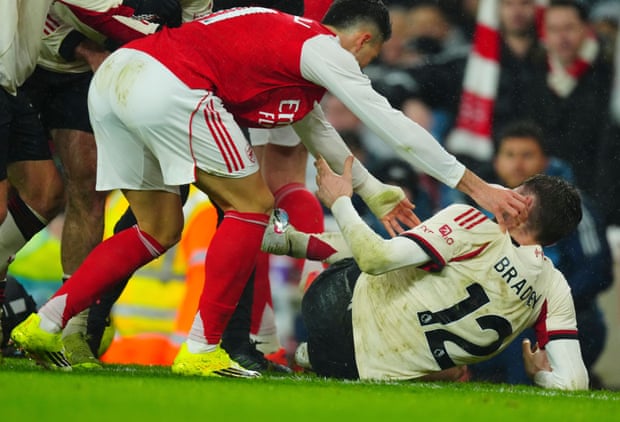
In a rare display of managerial solidarity across the touchline divide, both Mikel Arteta and Arne Slot came to the defense of Gabriel Martinelli following a controversial incident that overshadowed Arsenal’s goalless draw with Liverpool at the Emirates Stadium. The Brazilian forward narrowly avoided a red card after attempting to physically move an injured Conor Bradley off the pitch during stoppage time, sparking fierce debate about player conduct and the growing culture of gamesmanship in the Premier League.
The incident occurred in the dying moments of a tense, bad-tempered encounter that saw Liverpool extend their unbeaten run to 10 matches across all competitions while denying Arsenal the chance to open an eight-point gap at the top of the table. With Arsenal desperately pushing for a late winner in the 94th minute, Bradley collapsed with what appeared to be a serious knee injury. Rather than allowing the Liverpool defender to receive treatment, Martinelli attempted to drag him off the field of play—a moment that drew immediate condemnation from Sky Sports pundits Gary Neville and Roy Keane, with Neville calling the 24-year-old an “idiot” for his actions.
Yet in the post-match analysis, both managers took a surprisingly unified stance in defending Martinelli’s character while acknowledging the broader context that led to the flashpoint. Arsenal boss Arteta was quick to vouch for his player’s integrity, saying: “Knowing Gabby, if anybody knows Gabby, it’s an incredibly lovely guy and probably he didn’t realise what happened. I hope that Conor is well. I will have a word with him now to understand that, but probably he didn’t recognise what happened.”
More remarkably, Liverpool manager Slot—whose player was the victim of Martinelli’s actions and who now faces the prospect of losing Bradley to what he described as an injury that “doesn’t look good”—also refused to condemn the Arsenal forward. Instead, the Dutchman pointed to football’s escalating problem with time-wasting and simulation as the root cause of such incidents.
“I’m 100% sure that if he knew what the injury might be, that he would never do that,” said the Liverpool manager. “But it doesn’t look great if he has the injury, which we fear he might have, of course. But football, time-wasting, diving has come to the situation that players think in the 94th minute that probably that is happening again. Because I’ve seen it happening against us so many times this season that I can understand that Martinelli might have thought that this was time-wasting as well.”
Slot’s comments reveal a troubling reality about modern football: the culture of gamesmanship has become so pervasive that even genuine injuries are now viewed with suspicion. His acknowledgment that Liverpool themselves have been victims of time-wasting tactics “so many times this season” adds weight to his argument that Martinelli’s actions, while inappropriate, stemmed from a reasonable assumption rather than malicious intent.
The incident raises important questions about where the line should be drawn between competitive intensity and respect for player welfare. While Martinelli’s attempt to remove an injured opponent from the pitch clearly crossed that line, both managers’ willingness to contextualize his actions within the broader problem of tactical gamesmanship suggests a growing frustration with how the dark arts have infiltrated the beautiful game.
Bradley will undergo a scan to determine the extent of his knee injury, with Slot confirming his fears about its severity. The Northern Irishman had earlier come closest to breaking the deadlock when he struck the crossbar in the first half, making his potential injury an even more bitter pill for Liverpool to swallow.
For Arsenal, the draw represents two points dropped in their title challenge, particularly given Manchester City’s recent slip-ups that had presented an opportunity to extend their lead. The failure to capitalize on their rivals’ vulnerabilities, combined with the controversy surrounding Martinelli’s conduct, means this will be remembered as a frustrating afternoon at the Emirates.
What makes this incident particularly noteworthy, however, is not just the controversy itself but the united front presented by two title-rival managers in defending a player’s character while calling out systemic issues within the game. Their shared perspective suggests that football’s governing bodies need to address the culture of time-wasting and simulation before it further erodes trust and sportsmanship on the pitch.
As Martinelli likely reflects on his actions and prepares for his conversation with Arteta, the incident serves as a cautionary tale about how the normalization of gamesmanship can lead even “incredibly lovely” players to make poor split-second decisions in the heat of battle. Whether football can address this cultural problem before it leads to more serious consequences remains to be seen.
Original reporting from The Guardian (UK)
NEWS NOW: