


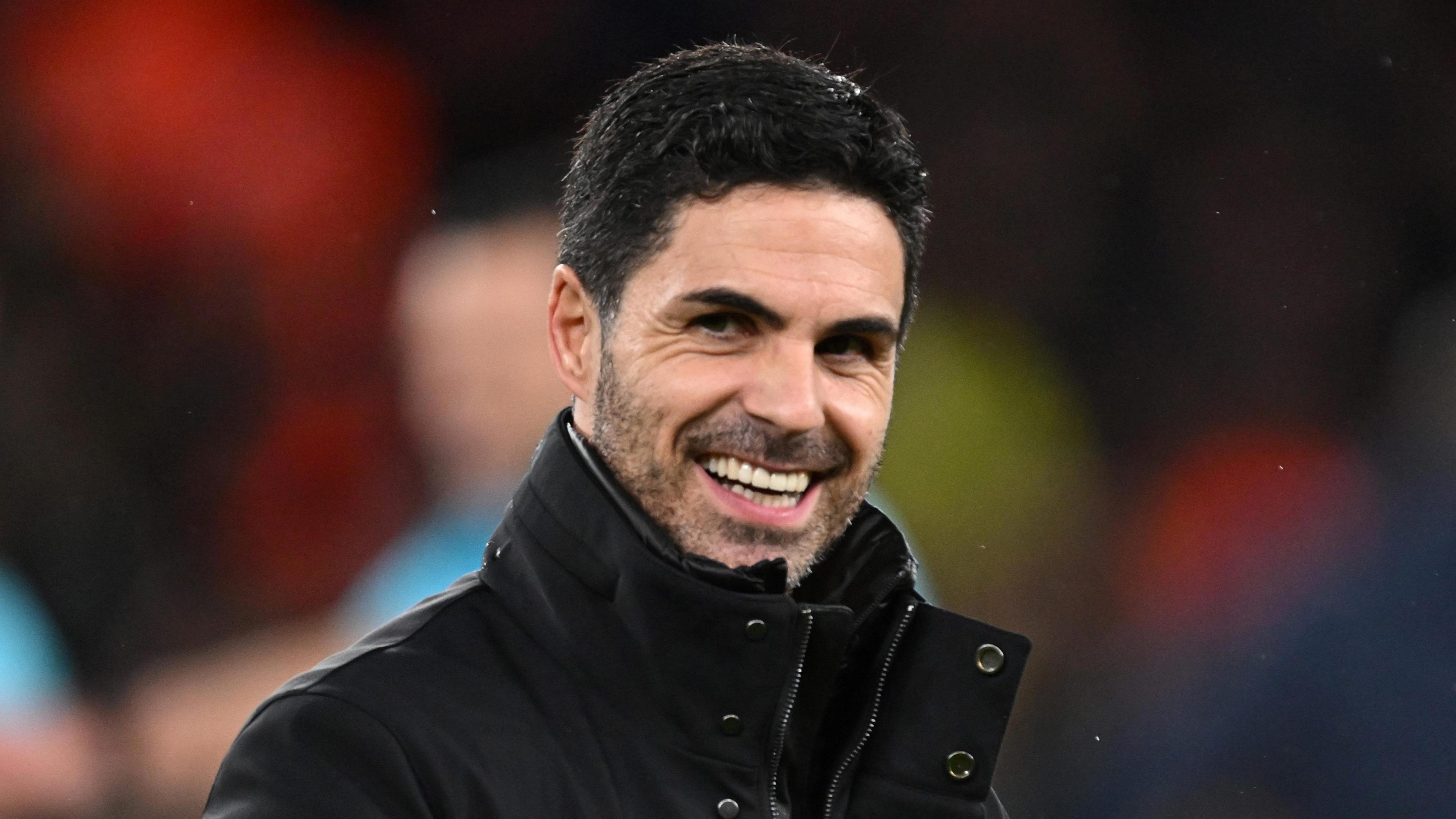
Arsenal boss Mikel Arteta started his managerial career facing comparisons with Pep Guardiola before more recently being likened to José Mourinho.
The Guardiola link was inevitable, a product of their friendship dating back to 1997. Arteta first met his idol at the Barcelona academy before working under him at Manchester City for three years as a coach. They view the sport the same way, and Arteta’s Arsenal would look to embody many of the same traits.
The parallel with Mourinho is a more recent occurrence, a consequence of the Gunners’ evolution into a physically imposing side primarily founded on resolute defending.
But that note of conservatism within their composition this season brings Arteta to a point analogous with a third manager: Gareth Southgate.
Arteta in 2025-26 is in a remarkably similar position to then-England boss Southgate at Euro 2024. Both managers took over teams in a disparate state, restored their culture and credibility on the biggest stage and had come agonizingly close to delivering the major trophy their fanbases crave. The final test is this: Can the team that you’ve admirably transformed into a powerful force seize the moment and win silverware?
Southgate came painfully close again last summer, but left his role in July after England lost the final 2-1 to Spain. Despite reaching back-to-back European Championship finals, the soundtrack to England’s campaign was acrimonious. Expectations had increased as England assembled their most dynamic squad in a generation, just as Arsenal arguably possess now. Southgate was accused of “playing with the handbrake on,” the exact criticism Arteta faced after Arsenal lost 1-0 at Liverpool in August and again when drawing 1-1 against Manchester City last month.
How Arteta responds over the course of the campaign will go a long way to deciding whether the Gunners can win their first Premier League title since 2004. Ending, if you will, 22 years of hurt. Southgate’s experience should serve as a warning because he had more in common with Arteta to this point than you might think.
Inheriting a mess
A lot of managers talk about cultural change, but few actually achieve it. Southgate inherited an England team that had just suffered one of the worst results in its history by losing to Iceland at Euro 2016, which was Roy Hodgson’s final game in charge. To compound the mess, Sam Allardyce lasted just 67 days as his successor before being caught up in a newspaper sting revealing his apparent willingness to advise on circumventing Football Association rules on transfers.
Essentially, the England team was broken. Players felt the weight of the shirt and history on their shoulders. Southgate stepped in as a young manager inexperienced at the highest level, hoping to draw on his experience as a former England player of 57 caps.
At Arsenal, Arteta took over from Unai Emery in December 2019 with the club still struggling to escape the shadow of Arsène Wenger’s glory days. Wenger had fumbled around in that darkness long enough, and Emery was only briefly capable of dragging them into the light before his sacking after 18 months in charge.
The dressing room was fractured and supporters felt disconnected from the team, albeit primarily focusing their frustration on American owners Kroenke Sports Enterprises. Arteta was a young manager inexperienced at this level but with an innate understanding of Arsenal’s core thanks to five years as a player at the club between 2011 and 2016.
Both utilized innovation in different fields. Southgate once took England on a training camp with the Royal Marines, while Arteta recently revealed he sought the advice of RAF fighter pilots to explore ways his players could improve their communication.
Both needed to redefine the team before they could think about trying to win anything big. Arteta’s 2020 English FA Cup triumph gave him the authority to do so in the same way Southgate’s 2018 FIFA World Cup semifinal run validated his methods.