


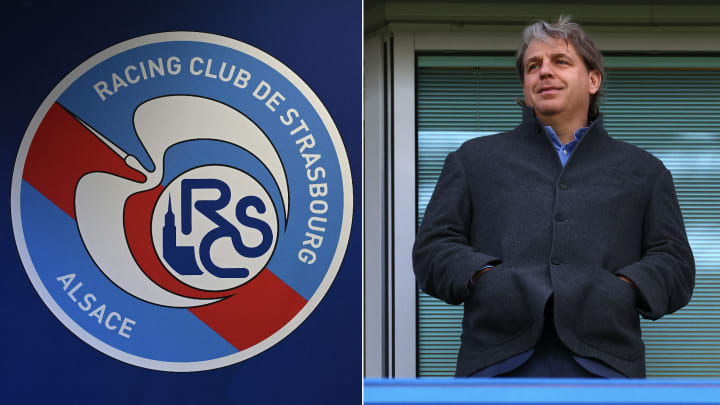
Strasbourg fans who initially welcomed BlueCo’s investment that brought £157 million in stadium improvements, record transfer spending, and on-pitch success under Liam Rosenior are now experiencing the harsh reality of multi-club ownership after the manager’s mid-season departure to Chelsea exposed them as the subservient partner in a structure critics call “a symbol of everything that is wrong with modern football.”
Most Strasbourg fans initially believed they had struck a golden deal with BlueCo. Since the 2023 takeover by Todd Boehly and Clearlake Capital, the transformation has been undeniable.
The club is competitive in Ligue 1, finished atop their UEFA Conference League table last month, and is benefiting from a £157 million revamp of the Stade de la Meinau.
The financial gulf between the old regime and the new is staggering; before BlueCo, annual transfer spending peaked at £9.5 million.
In the three seasons since, spending has skyrocketed to £52.6 million, £53.6 million, and a massive £96.5 million, even outspending giants like Paris Saint-Germain last summer.
However, the “BlueCo honeymoon” ended abruptly last week when manager Liam Rosenior departed mid-season to take the reins at Chelsea.
For many, this move exposed the grim reality of the multi-club ownership (MCO) structure: no matter how much money is spent, Strasbourg is the subservient partner.
L’Equipe journalist Cyril Olives-Berthet notes that the move has caused “utter shock” in France, suggesting BlueCo has “shot themselves in the foot” regarding their public image.
While Gary O’Neil has arrived as a successor, fans are skeptical of his experience compared to the exciting brand of football Rosenior established.
The perception of being a “feeder club” is no longer a conspiracy theory to the club’s ultras, who famously protest by staying silent for the first 15 minutes of matches.
Alexandre, a spokesperson for the supporters’ federation, views Rosenior’s exit as a “symbol of everything that is wrong with modern football.”
He argues that while ambition is natural, “leaving your team in the middle of a season, that’s not OK.” To these fans, Strasbourg has effectively become a “Chelsea B team,” a holding pen for talent destined for Stamford Bridge rather than a club with its own destiny.
Club president Marc Keller, who saved the club from the fifth tier in 2012, finds himself in an increasingly defensive position. He recently denied that the club had become a feeder operation, yet the evidence continues to mount.
Star striker and captain Emmanuel Emegha is already confirmed to join Chelsea this summer, a move that prompted fans to demand he return his captain’s armband.
Regarding Rosenior’s exit, Keller admitted: “Liam’s departure wasn’t planned… The situation was neither planned nor desired by anyone at the club. Sometimes, you have to adapt in football.”
Finance expert Kieran Maguire describes the Chelsea-Strasbourg link as “unique” and more akin to a hedge-fund strategy than traditional football growth.
BlueCo targets young assets—Strasbourg currently boasts the youngest squad in Europe’s top five leagues—locks them into long-term contracts, and waits for their value to mature.
“Strasbourg are perhaps slightly adrift in the sense they are seen as a holding area of talent that perhaps Chelsea want to bring to the club at a later point,” Maguire explains.
The goal is high returns on low-value assets, effectively treating players and managers as corporate employees ready for promotion to the “core” London office.
The data supports this “holding area” theory. To date, 11 players have moved between the two clubs. Some moves, like the loan of Ben Chilwell, provided immediate quality.
Others are more puzzling: 19-year-old Ishe Samuels-Smith joined Strasbourg from Chelsea in July, only to be recalled on deadline day in September and sent to Swansea.
Similarly, defender Mamadou Sarr was sold to Chelsea only to be immediately loaned back to Strasbourg.
These “inter-MCO” transfers raise serious questions about competitive integrity and the actual purpose of the French outfit.
While BlueCo can point to record sales—such as the £30.3 million received from Nottingham Forest for Dilane Bakwa—as proof of a successful model, the human cost is mounting.
Strasbourg fans recently displayed banners in solidarity with Crystal Palace supporters, who saw their club demoted to the Conference League due to MCO conflict rules.
As UEFA and FIFA struggle to regulate these behemoths, the fans at the bottom of the food chain are left with a bitter realization: in a multi-club world, even when you win on the pitch, you might be losing your club.