


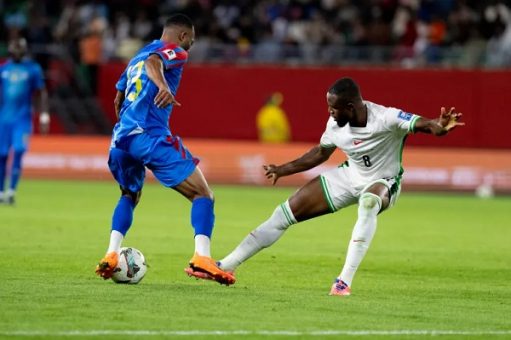
The clash between Nigeria and the Democratic Republic of Congo in the African qualification pathway for the 2026 FIFA World Cup has grown into one of the most complex and controversial football stories of 2025.
What began as a high-stakes playoff match has since evolved into a dispute involving eligibility rules, national citizenship laws, and FIFA’s interpretation of international sporting regulations.
The outcome of this case could yet reshape Africa’s final representation at the World Cup.
The more serious development came in December 2025, when the Nigeria Football Federation submitted a formal petition to FIFA. The complaint alleged that DR Congo fielded several ineligible players during the playoffs, based on the country’s domestic citizenship laws.
Citizenship rules in DR Congo
Under the constitution of the Democratic Republic of Congo, dual citizenship is generally not recognised. The law states that Congolese nationality is exclusive, meaning a citizen should not hold another nationality at the same time unless specific legal steps are taken.
Nigeria’s argument rests on the claim that several DR Congo players, many of whom were born or raised abroad, may not have formally complied with Congolese nationality requirements before representing the national team.
While these players reportedly held Congolese passports, Nigeria contends that possession of a passport alone does not automatically satisfy domestic legal obligations under Congolese law.
FIFA’s stance on player eligibility
FIFA’s eligibility framework is based on sporting nationality rather than domestic constitutional law. To represent a country, a player must hold that country’s nationality and, where applicable, complete FIFA’s one-time switch process if they previously represented another nation.
In most cases, FIFA considers a valid passport sufficient proof of eligibility. FIFA does not typically enforce or interpret a country’s internal citizenship laws unless there is evidence of falsified documentation or misrepresentation. DR Congo’s players were cleared by FIFA prior to the qualifiers, which forms the basis of the Congolese federation’s defence.
Chances of any outcome and what the rules say
As things stand, DR Congo’s position remains strong from a regulatory standpoint. At the time the playoff match against Nigeria was played, all DR Congo players involved had been officially cleared and deemed eligible under FIFA’s eligibility rules.
Each player held valid Congolese nationality documents and had received approval through FIFA’s established clearance processes where required. From FIFA’s perspective, eligibility is determined at the point of competition, not retroactively unless evidence of falsification or misrepresentation is proven.
This significantly reduces the likelihood of an outright reversal of the match result. Historically, FIFA has been reluctant to overturn on-field outcomes when players were cleared before kickoff and participated in good faith under existing regulations.
Unless Nigeria can demonstrate that FIFA was misled through fraudulent documentation or that critical information was deliberately withheld, the most probable outcome is that the result will stand.
While the investigation continues, precedent suggests that DR Congo’s advancement to the inter-confederation playoffs remains intact, with Nigeria’s chances hinging more on procedural interpretation than sporting merit.
The current situation
FIFA has acknowledged receipt of Nigeria’s petition and is reviewing the case. The investigation is ongoing, and no final ruling has been announced. Possible outcomes range from the complaint being dismissed, to administrative sanctions, or in extreme circumstances, a reversal of results.
However, overturning a match result is rare and would require strong evidence of regulatory breach.
Meanwhile, DR Congo remains scheduled to participate in the inter-confederation playoffs for the 2026 World Cup, pending FIFA’s final decision.
Nigeria’s qualification hopes now rest entirely on the outcome of this administrative process rather than on-field performance.
Why this dispute matters beyond Nigeria and DR Congo
The case has wider implications for international football, especially in Africa, where many national teams rely heavily on diaspora players.
It highlights the tension between domestic citizenship laws and FIFA’s global eligibility system, and raises questions about whether greater alignment or clarification is needed.
Whatever FIFA decides, the DR Congo vs Nigeria World Cup battle of 2025 will be remembered not only for its dramatic penalty shootout, but also for the legal and regulatory questions it has forced football’s governing bodies to confront.