


Arsenal’s pursuit of an unprecedented quadruple has sparked a fierce debate among football legends and rivals who claim Mikel Arteta’s win-at-all-costs “percentage” football is making the beautiful game less beautiful.
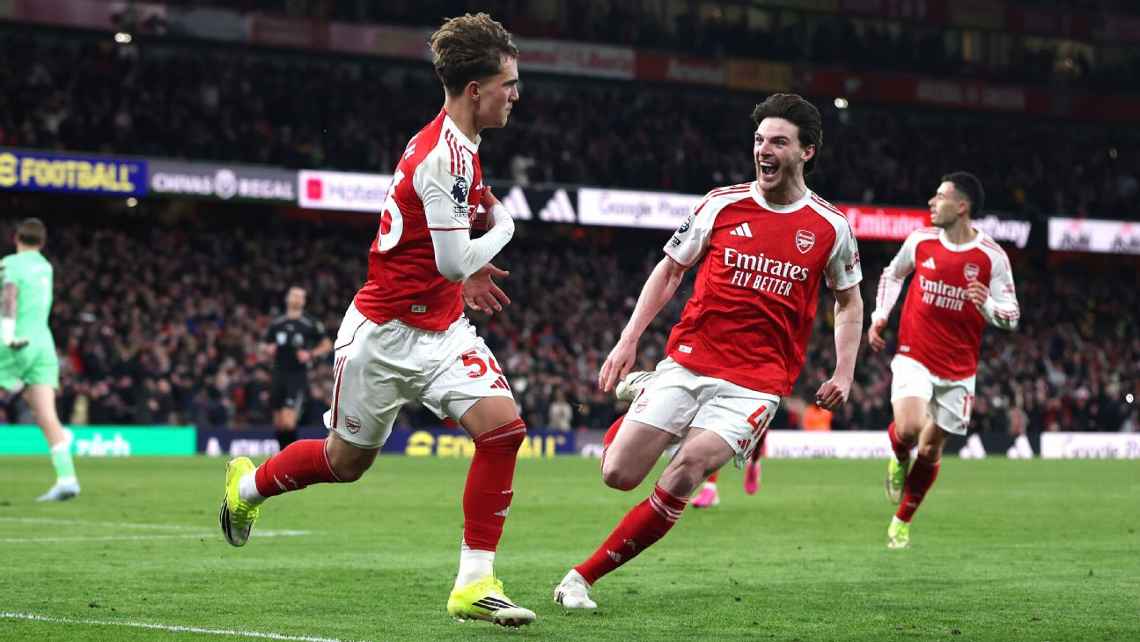
The Premier League title race just took a turn for the cinematic. This past weekend, 16-year-old wonderkid Max Dowman didn’t just score a historic goal to seal Arsenal’s 2-0 win over Everton—he briefly did the impossible: he made Mikel Arteta’s Arsenal actually likeable.
For a few fleeting moments, the Emirates was filled with the kind of “off the cuff” magic that usually feels strictly prohibited under Arteta’s rigid regime.
But as the dust settles on Dowman’s heroics, a darker conversation is brewing. While Arsenal sits on the precipice of an unprecedented quadruple, a growing chorus of legends and rivals are asking: Is this team actually bad for the sport?
The Ugly Road to Greatness
Arsenal is currently a statistical juggernaut, yet they are arguably the least popular league leaders in recent memory.
The criticism isn’t coming from trolls; it’s coming from the hierarchy of the game. Following a recent 1-0 win, Brighton coach Fabian Hurzeler took aim at Arsenal’s “time-wasting” tactics.
The pundits have been even more scathing. Paul Scholes recently remarked that the Gunners would be the “worst team to win the league,” while Peter Schmeichel noted that Arsenal play an “ugly brand of football that is annoying to watch.”
The irony is thick. This is a team that could surpass the 1999 Manchester United Treble or the 2004 “Invincibles.”
Yet, while Arsène Wenger’s side earned global adoration for their breathtaking style, Arteta’s squad is viewed as a collection of “percentage players” who have traded soul for silverware.
The Set-Piece Science
The numbers back up the “boring” narrative. Arsenal has become the most dangerous set-piece team in Europe’s top five leagues, netting 21 goals from dead-ball situations this season. That accounts for a staggering 34.4% of their league goals.
While Sir Alex Ferguson’s 2007-08 United side also relied heavily on set pieces (35%), they did so with the flair of Cristiano Ronaldo, Wayne Rooney, and Carlos Tevez.
Arteta’s Arsenal, by contrast, lacks that individual superstar gravity. Aside from Viktor Gyökeres (16 goals) and Gabriel Martinelli (11), the scoring is a democratic, if uninspiring, effort.
The goal showcased all the attributes that Arteta’s Arsenal have not only lacked this season, but perhaps even deliberately stifled as they have reduced their game to one of percentages.
The Danger of Imitation
The real concern for football purists isn’t just that Arsenal is winning—it’s that they are winning in a way that others will inevitably copy.
Football is a game of imitation. Just as Pep Guardiola’s “tiki-taka” and ball-playing goalkeepers like Gianluigi Donnarumma became the global blueprint, “Artetaball” is starting to take root.
We are already seeing mid-table clubs obsessing over marginal gains and Jover-inspired corner routines.
If Arsenal secures the Premier League and the Champions League this season, the “direct” and “stifled” approach will become the new gold standard. It is a win-at-all-costs philosophy that views risk as a defect rather than a delight.
The Dowman Paradox
Max Dowman’s goal was a reminder of what we’re missing. It was about adventure and individuality—the very things Arteta has spent years coaching out of his system in favor of control.
Comparing Arsenal to the current European elite reveals a stark aesthetic gap.
While Luis Enrique’s PSG is “blowing teams away” with the free-flowing flair of Ousmane Dembélé and Bradley Barcola, Arsenal is grinding out results through defensive solidity and tactical fouls.
Arteta has unquestionably found a winning formula, but as we look toward a potential trophy parade in North London, we have to ask what it cost.
If the future of football looks like a 90-minute battle of marginal gains and set-piece headers, the “dream moments” provided by kids like Dowman will become increasingly rare.
Arsenal might win everything this year, but in doing so, they might just be making the beautiful game a little less beautiful.